The Goat That Never Returned—And the Son Who Did
Each year on Yom Kippur, two goats stood before the high priest in Jerusalem—one chosen “for the Lord,” the other designated “for Azazel,” the wilderness goat figure associated in early Jewish tradition with chaos, impurity, and the demonic realm. The first goat was sacrificed and its blood carried into the Holy of Holies to cleanse the sanctuary. The second goat, the wilderness goat, had the sins of Israel placed upon its head, after which it was driven outside the camp and into the wilderness.
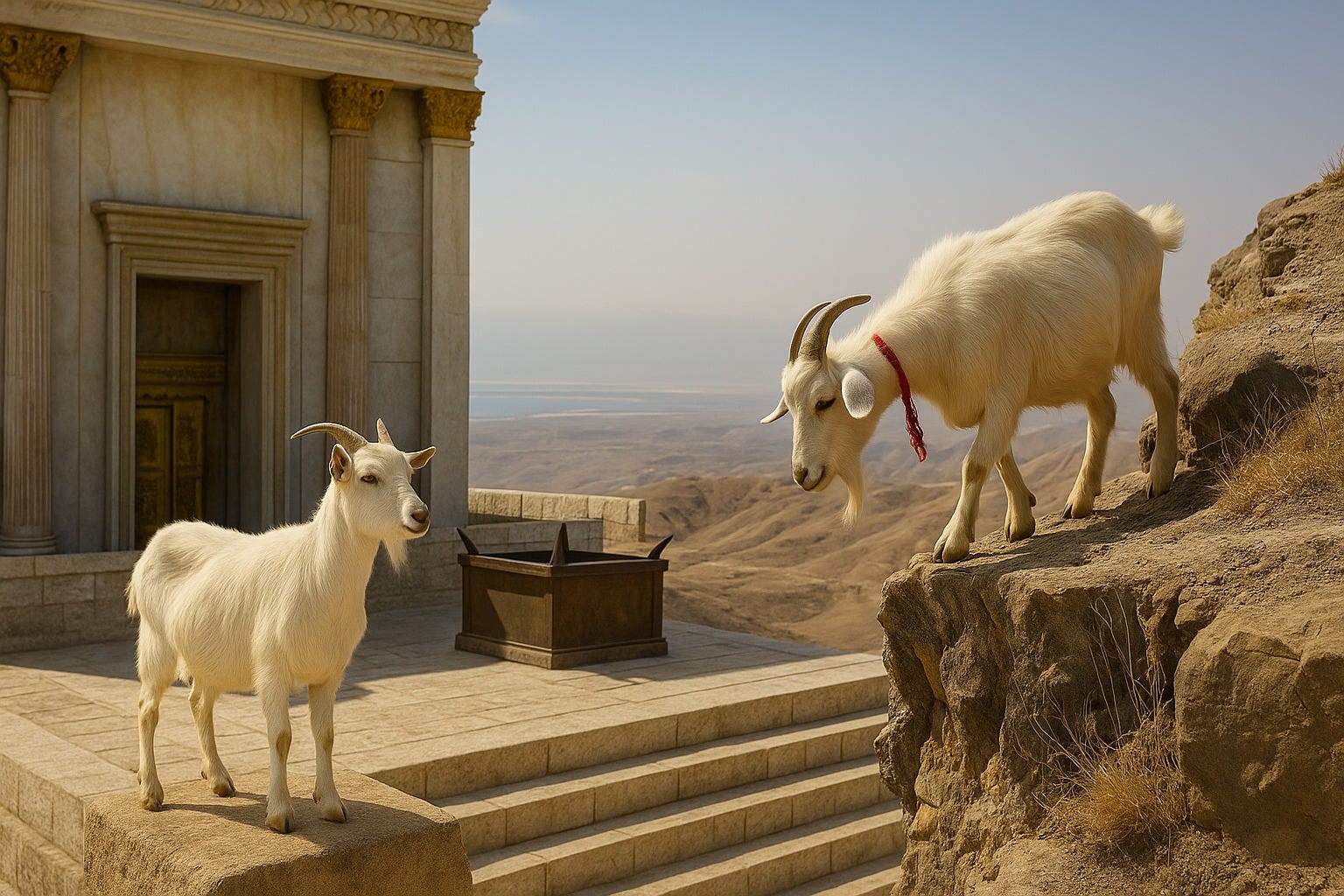
Later rabbinic tradition preserves a stark detail: the wilderness goat was pushed off a cliff so that Israel’s sins could never find their way back into the camp. One goat’s blood restored holiness within the sanctuary; the other, the wilderness goat, removed pollution from the community. Yet the ritual, powerful as it was, remained temporary. The goat could bear sins away for a time but could not conquer them; the ritual had to be reenacted every year.
The Wilderness Goat Symbolized Exile and Chaos
In the Hebrew imagination, the wilderness was more than a wasteland. It represented the borderlands of creation—the space where the ordered world gave way to chaos, danger, and scarcity. It was the place of wild beasts and demons. Symbolically, the space was tied to exile.
Yet paradoxically, it was also the place where God reshaped His people. Israel’s forty-year wandering was both a discipline accompanied by God’s mercy, and the crucible where the nation was humbled, tested, and ultimately restored at Sinai. The wilderness held both judgment and new creation, the threat of death and the possibility of transformation.
And Isaiah presses further. If Yahweh once subdued chaos and established creation, He will do so again—not by repetition, but by new creation. “The eyes of the blind shall be opened, the ears of the deaf unstopped; the lame shall leap like a deer, and the tongue of the mute shall sing. For waters break forth in the wilderness” (Isa. 35). The place once defined by scarcity will overflow with life. The exiled will return with singing to Zion (Isa. 35:10). A highway will be there, a road called the Highway of Holiness (v. 8)
.The wilderness is no longer merely the place of banishment—it becomes the path of return.
Jesus Driven Into the Wilderness
Immediately after His baptism and anointing as the beloved Son—the Spirit “drove” Jesus into that same wilderness (Mark 1:12). This was not a retreat into solitude but a deliberate symbolic confrontation with the forces Israel had battled for centuries.
Second Temple writings such as 1 Enoch and Jubilees associate Azazel with haSatan, the adversary, the devil and accuser. If the goat “for Azazel” carried Israel’s sins into the domain of demonic powers, then Jesus’ entry into the wilderness is the counter-movement: He enters the realm where sin was banished in order to defeat the power behind it.
The wilderness goat wandered into chaos and never returned; Jesus enters the same chaos but emerges victorious. He becomes the faithful Israelite who withstands temptation, the obedient Son who succeeds where Adam and Israel failed, and the greater Moses who ascends the mountain without compromise.
This is where the New Testament reframes the ancient combat myth. Jesus does not conquer chaos through violent upheaval, but through healings, deliverance, exorcisms, and humble obedience to the Father. And in His final battle—on a Roman cross—the Divine Warrior lays down His life in total surrender.
The Servant and the New Exodus
The Servant in the Isaiah passages (Isa. 40–55) follows this same path: bondage, deliverance, wilderness suffering, and eventual glory. Through this figure, Isaiah frames the coming salvation. In this new Exodus, the Servant becomes the agent through whom Yahweh brings redemption.
He is the new Moses, the covenant mediator, the sacrificial lamb, the faithful Israelite, and the king enthroned through obedience and suffering. The Servant fulfills Israel’s vocation and extends its mission to the whole world. Through Him, God’s salvation reaches the ends of the earth.
Exile Reversed: Retracing the Yom Kippur Path
The connection between Jesus and the wilderness goat becomes even clearer within the passion narratives. Hebrews notes that Jesus “suffered outside the gate in order to sanctify the people through His own blood” (Heb. 13:12).
Like the wilderness goat, He is expelled beyond the sacred boundaries, crucified outside Jerusalem’s walls—symbolically a place of exile. There, on Roman wood instead of jagged cliffs, He bears the burden of Israel’s sin “in His own body on the tree” (1 Pet. 2:24).
In Him the two goats converge: like the goat “for the Lord,” His blood purifies the true heavenly sanctuary; like the goat for Azazel, He carries sin outside the camp into death itself. But the great reversal lies in what happens next. Unlike the goat, Jesus does not remain in exile. He returns with victory.
The desert geography illuminates this reversal. The wilderness goat traveled eastward from the Temple, across the Kidron Valley, up the Mount of Olives, and down into the Judean wilderness toward the Dead Sea—the great basin. It symbolized Israel’s sin being carried away from the presence of God.
Jesus retraces this same route—but in reverse. He begins east of the Jordan, moves through the wilderness, ascends the Mount of Olives, and enters Jerusalem. It is the same homecoming path once walked by those returning from exile.
He is the rejected David who fled Jerusalem weeping over the Mount of Olives—and the king who returns in triumph. The path of exile becomes the path of restoration.
The Highway, the Procession, and the Returning King
Isaiah’s vision of the Highway of Holiness now comes into focus. In ancient Israel, the Ark of the Covenant once moved with the people, leading them through the wilderness, across the Jordan, and into battle. The Ark traveled along a fixed processional route—the mesilla—the sacred ascending road leading to the Temple.
This road became the liturgical artery of Israel’s worship, filled with pilgrims ascending to meet Yahweh in His sanctuary. It was a visible enactment of return, restoration, and divine presence.
Jesus’s journey embodies this same movement. He travels the wilderness road, confronts chaos, and ascends toward the city—not merely as a pilgrim, but as the King. The highway is no longer only a road; it becomes a person.
The wilderness highway has been cleared. Now Israel is invited to return, and the nations are invited to come—not merely to a city, but to the presence of God on a mountain. The cosmic mountain is wherever the King is enthroned. And by the Spirit, that mountain expands, reaching to the ends of the earth until “the knowledge of the glory of Yahweh covers the earth as the waters cover the sea” (Hab. 2:14).
The Crimson Thread and the Once-for-All Offering
Second Temple tradition also remembered a crimson thread tied to the goat’s horns, said to turn white when the ritual was accepted—a sign that Israel’s sins had been cleansed. Another crimson thread hung at the Temple’s Nicanor Gate, also turning white when atonement was granted.
But these were signs of temporary relief, yearly reassurances that God had once again removed impurity from His people. Hebrews insists that Jesus’ offering is “once for all” (Heb. 10:10). In Him the sign becomes the substance. No yearly banishment is required; no symbolic goat must be sent into the desert. Sin is not simply carried away—it is abolished at its roots.
The Wilderness Rewritten as the Place of Victory
With Jesus, the wilderness itself is reinterpreted. The terrain once associated with exile and demonic threat becomes the arena of divine triumph. The forces that held humanity in bondage are confronted and overcome. The chaos that once devoured becomes the doorway to new creation.
What was once the place where Israel’s sins were sent to die becomes the place where resurrection begins.
The New Exodus Has Begun
Jesus’ journey—through the waters of the Jordan, into the wilderness, up the mountain, and into the city—traces Israel’s story and brings it to completion. He descends into exile and emerges to lead His people home.
The writer of Hebrews therefore invites believers to follow Him “outside the camp” (Heb. 13:13), to share in His path of suffering and resurrection. To go to Him outside the camp is to join Him in His confrontation with chaos—and to return with Him in the power of new creation.
The Sin-Bearer Who Comes Back
The wilderness goat removes Israel from sin for a year; Jesus removes sin from Israel forever. The goat goes out and never returns; Jesus goes out and comes back in resurrection glory. The goat’s death provides temporary relief; Jesus’ death inaugurates the age to come.
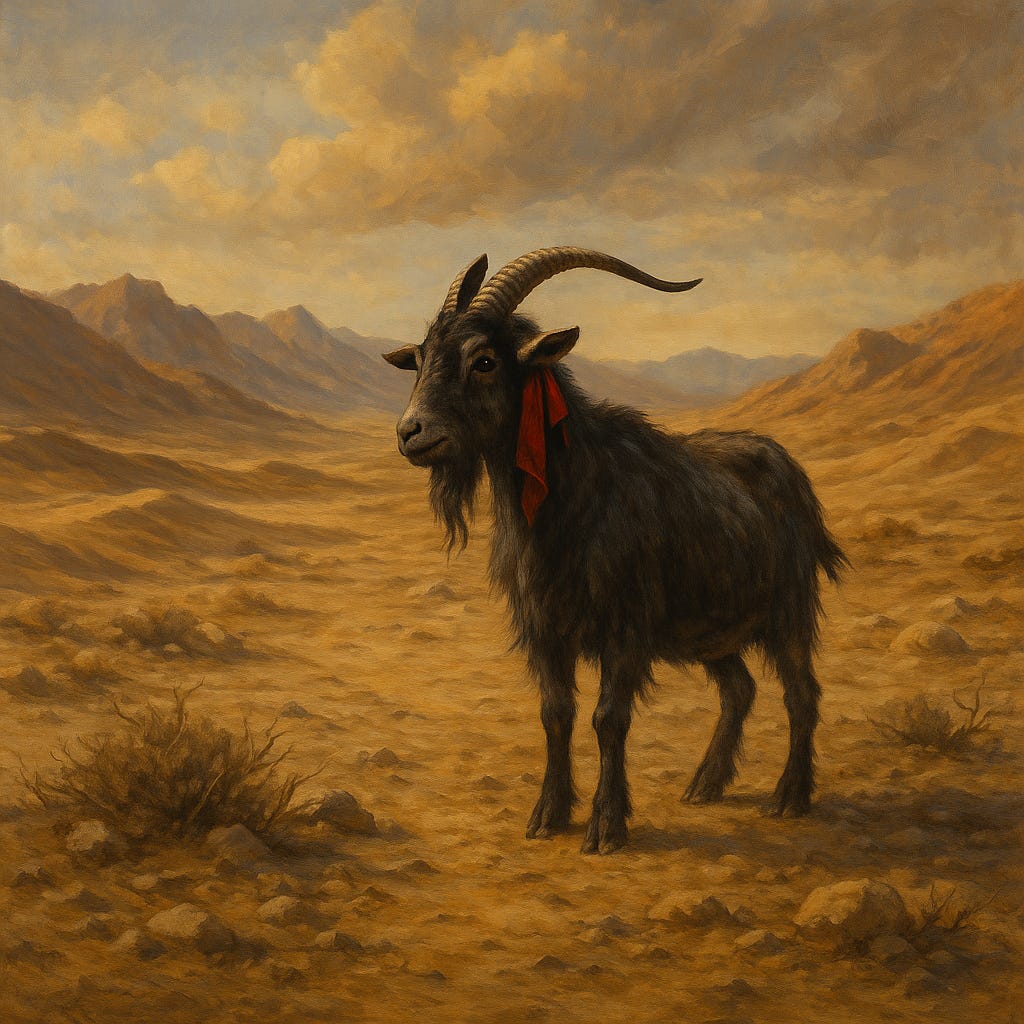
He is the true sin-bearer whose return signals the end of exile.
In this great reversal, Jesus emerges as the once-for-all wilderness goat, the returning Son of David, and the Divine Warrior whose victory transforms the landscape of atonement. He turns wilderness into worship and exile into Eden. In Him the end of the story comes into view: the God who once sent a goat away now sends His Son back to gather the nations home. Through Him, the wilderness is not the end; it is the doorway through which new creation dawns.
If you enjoyed this article then you’ll love my new book The Greatest Exodus. A Divine Warrior Tradition”
If you enjoyed this article, consider upgrading to support my ministry work. Thank you!