The Place He Chose
One of the great biblical themes is “the place that the LORD your God will choose to put His Name.” Moses directs Israel to one location where sacrifices are offered and covenant life is centered. This is the sacred center—the place where heaven and earth meet because God Himself chooses to dwell.
In the ancient world, names carried far greater significance than they do today. A name represented identity, character, authority, and existence itself. God reveals Himself to Moses as the One “who was and is and is to come,” the eternal One whose very Name declares His unchanging existence. To place His Name somewhere is to establish His presence, His rule, and His covenant authority there.
The Hebrew word is makom, meaning “place.” In Jewish tradition, HaMakom, “The Place,” becomes one of God’s titles. God, in a very real sense, is the Place. He is the One in whom all creation exists and finds its stability. The sacred place is where His presence is established, where His covenant is confirmed, and where His people come to stand before Him.
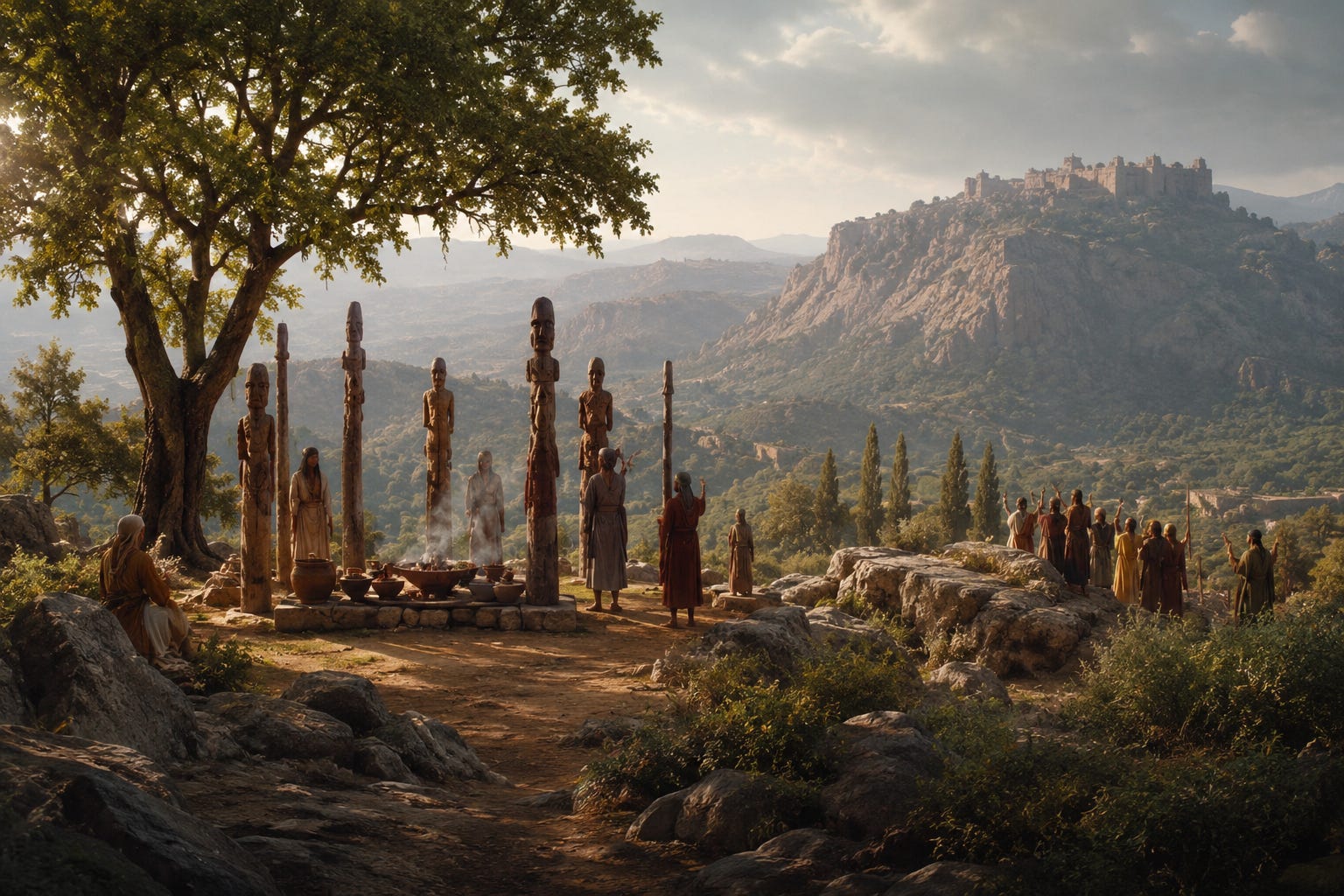
The nations saw sacred space differently. They believed their gods inhabited mountains, hills, and sacred groves. Elevated places became centers of worship. Every leafy green tree could become a place of fertility worship. Sacred poles and carved images marked locations where particular deities were believed to dwell. Every locality possessed its own sacred center. The nations themselves determined where their gods would reside.
Moses’ repeated reference to “the place where the LORD your God will choose to put His Name” only becomes clear when viewed against the ancient world’s understanding of sacred space. Every civilization believed there was a sacred center—the point where heaven and earth touched and where the divine realm intersected with human existence. It was considered the heart of reality itself, the place from which order flowed into the world and where creation was continually sustained.
Temples and sanctuaries were always built at this sacred center. But before a temple could be constructed, the sacred center first had to be identified. In the surrounding cultures this was often determined through oracles, omens, or divination. An image of the deity was then installed to validate the site’s sacred status, while the architecture of the sanctuary carefully reflected and protected its holiness.
Elevated mountains and hills naturally became favored locations because they symbolized the meeting point between heaven and earth. These sanctuaries functioned as miniature worlds, places where rituals and ceremonies renewed the relationship between the gods and humanity. In many ways they were understood as a microcosm of paradise—a center where the ordered world overcame the forces of chaos.
Israel also possesses a sacred center, but unlike the nations, it is never established by human initiative. The place is holy for one reason alone: the living God chooses it. From Eden onward, sacred space exists only because God establishes His presence there. It is where creation is restored and where His covenant people gather before Him.
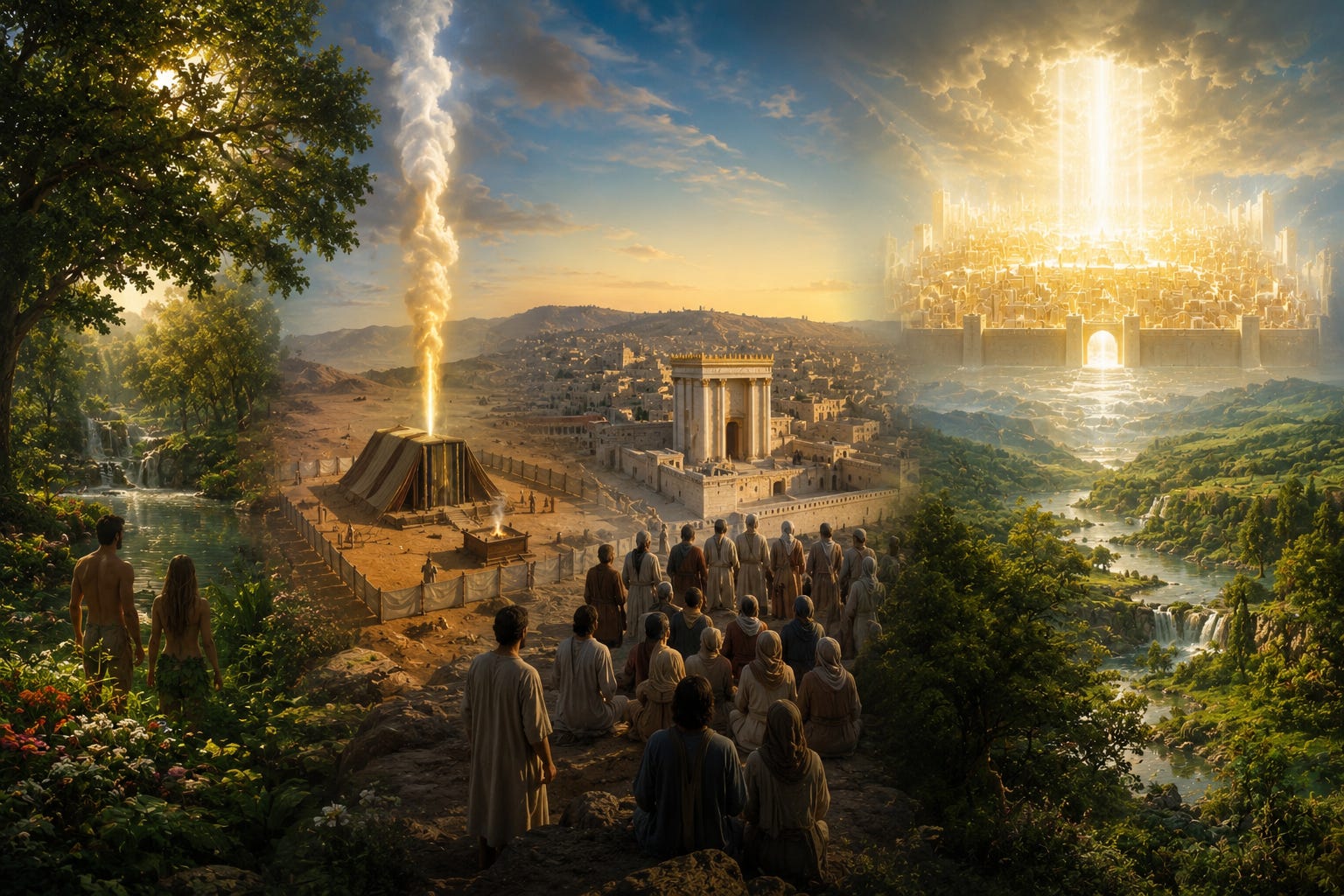
The nations chose where their gods would live. Israel waited for God to choose the place of His dwelling. The sacred center did not originate from human imagination. It originated from divine initiative. God planted the garden. He placed Adam and Eve within it and walked among them. Eden became the first sacred center because God caused His presence to dwell there.
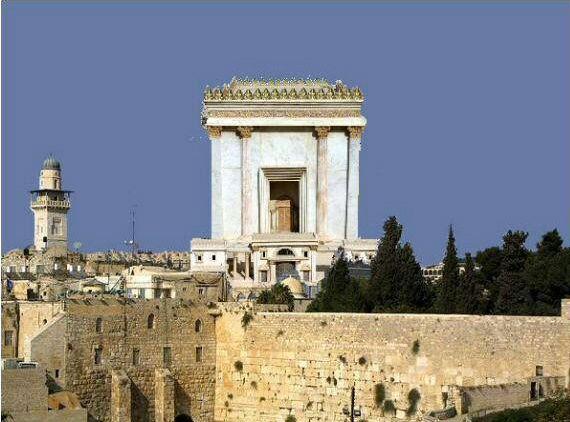
After humanity’s exile from Eden, God continually establishes places where His presence dwells. The patriarchs encounter Him in their tents and at divinely appointed locations. The Tabernacle in the wilderness becomes the center of Israel’s camp, where the glory of God dwells among His covenant people. Solomon’s Temple becomes the place where God causes His Name to dwell in Jerusalem.
Jerusalem certainly became that place within Israel’s history, yet it pointed beyond itself toward something greater.
The prophets looked beyond the earthly Temple toward a renewed creation where God’s presence would once again fill the entire world. The New Testament reveals that promise unfolding through the Messiah. John declares that “the Word became flesh and dwelt among us.” The language deliberately echoes the Tabernacle. God once again dwells among humanity, not in a building made with hands but in the person of Jesus Himself.
What began in a garden, moved through a tent and a temple, now lives within the covenant community. Revelation brings the entire movement to its glorious conclusion as the New Jerusalem descends from heaven. No temple stands within the city because God Himself dwells there. The whole renewed creation becomes the holy place. Heaven and earth are fully united once again.
God’s purpose has always been to restore His dwelling with humanity until His presence fills the whole earth. God meets His people everywhere through His Spirit. Yet humanity never determines where God dwells. We do not invite Him to bless our agendas, our kingdoms, or our ambitions. Instead, we are invited into His purposes.
God chooses.
We respond.
The place where God puts His Name is ultimately the place where His rule is welcomed. It is where His people willingly bend their will to His until His desires become their own. The sacred center is not defined by geography but by submission. It is the place where our plans yield to His purposes, where our desires are reshaped by His wisdom, and where our lives come into alignment with His covenant.
Throughout Deuteronomy, worship always gathers families, servants, strangers, and entire households before the Lord. They rejoice together in His presence because covenant life is lived in community. God’s dwelling is not simply about private spirituality; it creates a people who live under one King and one covenant.
While the nations scattered worship among countless sacred sites, Israel gathered around one sanctuary because there was one God, one covenant, and one King.
The same remains true today. The place where God chooses to put His Name is the place where His people willingly bend their will to His until His desires become their own. There chaos is overcome by God’s order, divided people become one covenant community, and self-rule is replaced by the reign of God’s Kingdom.
Every covenant community that lives under His rule bears witness to the day when all creation will become the place where He has chosen to put His Name.